
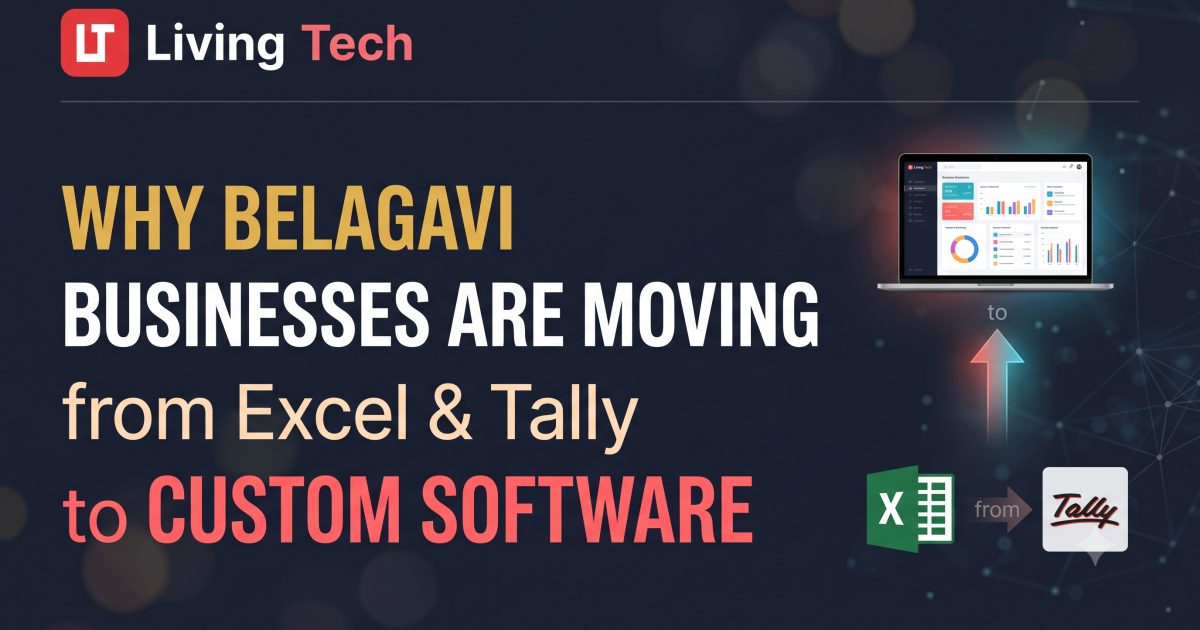
Excel and Tally are not the problem
Walk into almost any growing business in Belagavi and you will find the same setup. Accounts live in Tally. Orders, stock, production schedules and customer follow-ups live in a dozen Excel sheets. Someone, usually your most reliable employee, holds it all together with copy-paste, WhatsApp messages and memory.
That setup is not a mistake. Tally is built for accounting and does it very well, and most businesses should keep using it for GST, ledgers and statutory compliance. Excel is a genuinely good tool for analysis and quick calculations.
The trouble starts when these tools are stretched to run operations: tracking stock and orders, managing suppliers, following up on enquiries, keeping customer records and reports current. They were never designed for that, and the cracks show as you grow.
The question is never whether to abandon Tally. It is whether the operational work around it has outgrown spreadsheets.
Seven signs you have outgrown Excel and Tally
If three or more of these sound familiar, it is worth looking at alternatives.
- The same data is entered in more than one place. An order is written in a notebook, typed into Excel, then re-entered in Tally for the invoice. Every re-entry is a chance for a mistake.
- Only one person understands the master sheet. If one employee going on leave would stall the business, your process lives in a person rather than a system.
- Numbers never match. Stock in the sheet says 120, the godown says 95, and Tally says something else. When nobody trusts the numbers, every decision becomes a discussion.
- Several people edit the same file. Files named final_v3_NEW_updated and conflicting versions sent over WhatsApp are the classic signs.
- You find out about problems too late. A delayed payment, a stock-out or a missed follow-up is only noticed when someone happens to check.
- Reports take hours to prepare. If month-end means two days of collecting sheets and building summaries by hand, that time could go into running the business.
- Customers and staff expect more. Customers want status updates, quotations quickly and online payments. Staff want to work from their phones.
Why more Belagavi businesses are making the switch
Businesses across Belagavi, from finance firms and supermarkets to media and community platforms, are adding staff, branches and customers. As they do, the everything-on-one-computer approach breaks down. Custom software gives every location one shared, live view.
Off-the-shelf products rarely fit how you actually work. Generic ERP and CRM tools come with their own idea of your process, so you end up changing your business to fit the software, or paying for features you never use. Custom software is shaped around your workflow, your approvals and your reports.
Cost of ownership is worth looking at honestly rather than by the starting figure alone. Subscription tools charge per user, per month, forever, and add-ons keep stacking. Custom software has a higher starting cost, but you own the system and are not exposed to one vendor’s pricing changes.
Modern tools have also made this more affordable than it once was. Cloud infrastructure, ready-made components and AI-assisted development mean what needed a large budget can now start as a focused first version.
Automation frees your best people. When a system sends reminders, generates quotations, reconciles data and flags exceptions, your team stops chasing and starts deciding.
What custom software looks like in practice
Custom does not mean replacing everything. It usually means putting one operational layer in front of the tools you already run.
In most cases Tally stays as the accounting book. The new system handles operations and passes clean data across through a simple integration, so nobody types the same thing twice.
- Finance and accounting practices: automated capture from forms and documents, client follow-ups, and a clean hand-off of records to the accounts.
- News and media: content workflows, approvals, and subscriber or advertiser tracking in one place.
- Social and community platforms: member management, moderation workflows and reporting dashboards.
- Supermarkets and retail: stock, purchase orders, supplier follow-ups and sales reports across counters or stores.
An example from Belagavi
For one Belagavi income-tax practice, staff were entering client data into their system by hand. We built a CRM that automates that flow of manual data entry, designed to remove a substantial share of the re-typing rather than replacing the underlying practice software.
The result is less re-typing, data captured once at the point it is given, and more time for the work that genuinely needs a person. It is the kind of focused, process-first project we would start with.
We describe clients by sector rather than by name. If you would like to speak to a reference in your own industry, ask and we will introduce you where that is appropriate.
How to switch without disrupting your business
The fear of a big, risky change-everything project stops many owners, and it does not have to work that way. Our approach is small, reversible steps rather than one big switch.
- Start with the biggest pain point. Pick one process, such as order tracking or enquiry follow-up, that costs you the most time or money.
- Build a small first version. A working core tells you far more than a long specification document.
- Run it alongside your current process for a period, so there is no hard cutover.
- Connect it to Tally instead of replacing it.
- Add features in stages, guided by what your team actually uses.
- Make sure you own the code and documentation, so you are never dependent on one vendor.
Questions to ask before you hire a software company
Any credible firm should be comfortable answering all five of these before you sign anything.
- Can you show similar work in my industry?
- Will I own the source code?
- How will the system connect with Tally and my existing tools?
- Who will support it after launch, and what does support cost?
- Can we start with a small phase first?
Frequently asked questions
Do I have to stop using Tally? No. Most businesses keep Tally for accounting and compliance and add software that handles operations and integrates with it.
How much does custom business software cost? It depends on scope, and we do not publish figures. A focused first version costs considerably less than a full ERP, which is why starting small is usually the right approach. Any credible company will give a clear estimate after understanding your process.
How long does it take to build? It depends entirely on scope, and we do not publish timelines. A first usable version is usually built in stages so you can see something working early rather than waiting for one large delivery.
Is a local software company better than one in a big city? A local partner means easy meetings and quicker support. What matters most is real engineering skill and a clear process, and you can often get both close to home.
Will my data be safe? It should be. Ask about access controls, encryption and backups before you sign, and expect the answer to be specific.
Not sure whether you need custom software?
Bring the problem, not a brief. LivingTech is a software company based in Belagavi, and we will tell you honestly what we would do first, what we would avoid, and whether custom software is even the right answer for you.
Start a conversation or write to hello@livingtech.in.
Takeaways
- Tally and Excel are not the problem; stretching them into operations is
- If one person holds the master sheet, the process is not a system yet
- In most cases Tally stays, and a new layer handles operations and feeds it
- Start with the single process that costs you the most, not with a rewrite
- Own the code and the documentation