
Where the time actually goes
If you have ever walked into a college admission office in June or July, you know the scene. Files on every desk. Parents waiting in a line that runs out the door. Two staff members typing marks from a photocopy into a computer while a third one phones a student because the transfer certificate is missing.
None of this is anyone's fault. Admissions involve a lot of paper, and every piece of paper has to be read by a person, typed into a system, and checked against another piece of paper.
Ask any admission officer and they will tell you the application form is not the hard part. The hard part is everything around it. Each of those steps is small on its own, but multiply them by a few thousand applicants and they eat weeks of staff time. And a typing mistake made in week one has a way of turning up as a problem in exam registration six months later.
- Reading each marksheet, certificate and ID card and typing the details into the system
- Checking that the name, date of birth and register number match across documents
- Working out percentages and checking them against the eligibility rules for each course
- Calling or messaging students about documents that are missing or unreadable
- Building the merit list and matching fee receipts to the right applicant
What AI document processing actually does
Older OCR tools could read text, but only if the document looked exactly the way the software expected. A marksheet from one board, a different one from another board, a certificate in Kannada, a photo taken at an angle: each one was a separate headache.
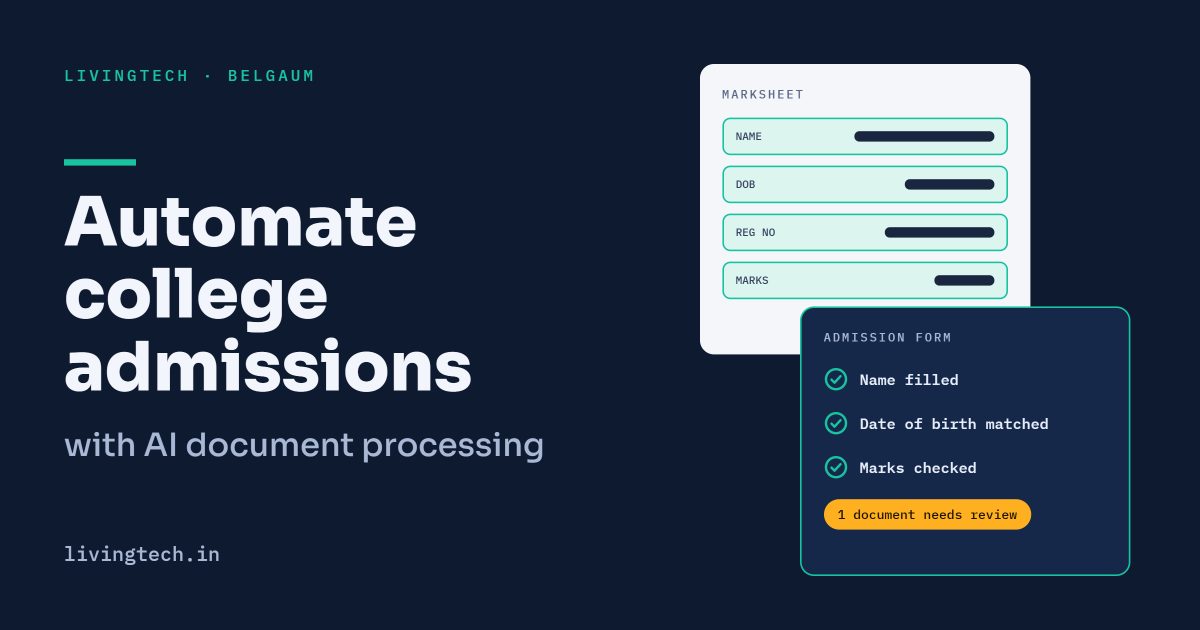
Newer document processing reads a page more like a person would. A student uploads a photo or a scan. The system finds the name, date of birth, register number, subject-wise marks and totals, even when the layout is different from the last document it saw. It puts those values into the right fields of the admission form and gives every value a confidence score.
That last part is what makes the whole thing work. A clear, printed marksheet gets a high score. A blurry photo taken in bad light gets a low one, and that one goes to a human to check. Let the machine handle the easy ones and send the doubtful ones to a person.
Any vendor who quotes a single accuracy number without testing your own documents is guessing. Accuracy is a property of your documents, not of the software.
What you can automate
Once the data is coming out of the documents on its own, a lot of the surrounding work can follow.
- Data entry. Marksheets, transfer certificates, caste and income certificates, ID proofs and photographs are read and the details filled in automatically.
- Cross-checks. The system compares the name and date of birth across every document and flags anything that does not match.
- Eligibility. Marks are totalled, percentages calculated, and each applicant is checked against the cutoff for the course they applied for.
- Follow-ups. Students who have missed a document get a message automatically, instead of a staff member making twenty phone calls.
- Merit lists. A draft list is ready the moment applications close, for your team to review and approve.
- Records. The approved data goes straight into your ERP or student database, so nobody types it a second time.
What I would not automate
The admission decision itself. Software can prepare, sort and flag. A person should approve.
The same goes for anything the system is unsure about. Those cases should land in a review queue, not get quietly accepted. A good setup makes your staff faster. It does not take them out of the loop.
If a member of staff cannot tell you which parts of the process a human still owns, the system has been set up wrong.
How to set it up, step by step
My advice is to start with one course or one intake, not the whole college. Run it alongside your normal process for the first batch, compare the results, and then expand.
- List your documents and fields. Write down every document you collect and exactly what you need from each. Most colleges find they ask for more than they ever use.
- Put a proper online application in front of the process. A simple admission form with document upload is enough. Phone photos work fine if the form tells students how to take them: good light, the whole page in the frame, no folds or shadows.
- Add the extraction step. Each upload is read, the form fills itself, and every value shows its confidence score.
- Set your rules. Same name on all documents, date of birth matches, marks meet the cutoff for the course.
- Give staff one review screen. Good items can be approved with a click. Doubtful ones open next to the image of the original so a person can check them in seconds.
- Send the approved data to your existing system. That might be an ERP, or even a well-organised spreadsheet. You do not have to replace what you use today.
- Automate the messages. Application received, document missing, fee reminder, merit list published.
Mistakes to avoid
Most of these are not technical problems. They are procurement problems, and they are cheaper to avoid than to fix.
- Chasing full automation. Aim to remove the routine work, not every human touch. The last stretch costs far more than the first, and it is the part where mistakes become unfairness.
- Ignoring input quality. If the upload is blurry, the result will be poor whatever software you use. Fix the input first, with clear instructions on the form.
- Forgetting regional languages. In and around Belgaum you will see Kannada, Marathi, Hindi and English documents, sometimes on the same desk. Ask any vendor to test on your real documents in every language you receive.
- Treating student data lightly. Aadhaar details, caste certificates and mark records are sensitive. Know where the data is stored, who can see it, how long you keep it, and take consent properly.
- Buying on a demo. Demo documents are always clean. Ask the vendor to run a hundred of your own messy ones and show you the results before you commit.
India's Digital Personal Data Protection Act applies to admission data. Treat consent and retention as design requirements from the start, not as paperwork afterwards.
How we think about this at LivingTech
We recently built a custom CRM for an income-tax practice in Belgaum, taking manual data entry out of their process. It is the same shape of problem that admissions presents: information stuck on paper or in photos, typed in by hand, and checked by eye.
College admissions is the same kind of problem with different documents. The documents change, but the pattern does not. We start with how your college actually works today and build the workflow around that, not the other way round.
We describe clients by sector rather than by name. If you would like to speak to a reference in your own industry, ask and we will introduce you where that is appropriate.
Frequently asked questions
How accurate is AI document processing for marksheets? It depends on the input quality, the document type and the language. Clean, printed marksheets do very well. Blurry photos and handwriting do worse. That is why every extracted value should carry a confidence score, with the doubtful ones going to a person.
Can it read handwritten forms? Partly. Neat handwriting can work, but messy handwriting needs a human check. It is better to have students fill in the application online and upload only the certificates.
Do we need to replace our current ERP or admission software? No. The extraction and checking can sit in front of what you already use and pass clean data into it.
How long does a pilot take? It depends mostly on how many document types you handle and how your current system accepts data. A focused pilot for a single course is deliberately small, which is why we would rather discuss the documents than quote a figure.
Is student data safe? It can be, if it is set up properly. Ask where the data is stored, who has access, how it is encrypted, and how it gets deleted when you no longer need it.
What does it cost? It depends on the number of document types, the volume of applications and how many systems it has to connect to. We do not publish prices. That is why starting with a small pilot and looking at real numbers beats deciding anything bigger on the basis of a proposal.
Planning for your next admission cycle?
Tell us how admissions work at your college today, what you collect, what you type in by hand, and where it slows down. We will tell you honestly which parts are worth automating and which are not.
Write to hello@livingtech.in.
Takeaways
- The application form is not the bottleneck; reading and re-keying documents is
- Every extracted value should carry a confidence score, and low scores should go to a person
- Never automate the admission decision, only the preparation and the checking
- Pilot one course alongside your current process rather than replacing it
- Fix input quality first, and test any vendor on your real documents in every language you receive